You Used to Want Sex. Now You Don't. And What Happened Isn't What You Think.
The 14-Day Reset That Actually Brings It Back — No Supplements, No Forcing It.

You love him. That part never left. But somewhere between the hospital bag and the sleepless nights, something else did: wanting to be touched quietly disappeared — and no one warned you it might not just come back on its own.
It's 1am, and you're feeding the baby again, one hand on the bottle, one thumb on your phone.
You've typed it before. "Why don't I want sex after having a baby." Tonight makes the fourth time this month.
Downstairs — or maybe right beside you — your husband is asleep. Or pretending to be. He's stopped asking. You've noticed that. The not-asking is somehow louder than if he had.
You are not broken. And in the next few minutes, I'm going to prove it to you.
Here's What Nobody Told You
Everyone hands you the same explanation — hormones, exhaustion, "it'll pass." Nobody hands you the actual mechanism.
This was never a desire problem. It's a safety problem.
Your nervous system went through something enormous during childbirth, and it is still doing exactly what nervous systems are built to do after something enormous: protect you. Desire cannot exist in a body that still believes it's on guard. Not because you're broken — because your biology is working correctly, just pointed at the wrong moment.
That's why the date night made things worse. Why the supplement did nothing. Why "just relaxing" was never something you could think your way into. None of them addressed safety. All of them tried to force desire directly, on top of a nervous system still bracing.
Once your body has real evidence that the danger has passed, desire doesn't need to be forced. It comes back on its own — the same way milk comes in. Biology, not brokenness.
The Backstory
My Story

My second son was born on a rainy Tuesday in Lagos, a little over three years ago. Easier delivery than my first. Healthy baby, healthy me — on paper, nothing was wrong.
But somewhere in those first few weeks, something in me quietly switched off.
It wasn't dramatic. No fight, no single moment either of us could point to. It was quieter — a hand on my back I found myself flinching from without meaning to. A goodnight kiss I turned slightly to avoid, then felt guilty about instantly. A closeness that used to feel like home now felt like a demand I couldn't meet.
I gave myself the six-week grace period everyone talks about. Six weeks came and went. Then three months. Then six.
That's when the real cost started showing up. I stopped changing in front of him. I started going to bed early, pretending to already be asleep. I'd catch him looking at me — not angry, just confused, a little hurt — and I'd look away first, every time, because I didn't have an explanation that made sense even to me.
Was I broken? Did I not love him the way I used to? Was this just what motherhood quietly took from every woman, and nobody warned me?
I never said any of this out loud. Not to my husband. Not to my own mother. I was supposed to be the one who had things figured out.
The breaking point came ten months in, on an ordinary Thursday. My husband reached for my hand across the couch — nothing more than that — and I pulled it away so fast it startled us both. He got up without a word and went to bed early.
I sat alone in the living room and cried in a way I hadn't let myself in months. Not because of what happened. Because of what it meant. I couldn't keep doing this to him. To us.
In the months after, I tried everything.
Date nights. We booked a sitter, dressed up, tried to recreate who we were before the kids. The pressure of the whole evening building toward something made everything worse, not better.
Lingerie, "spicing things up." I bought things I never wore. None of it touched the actual problem — my body wasn't rejecting romance, it was rejecting the fear underneath it.
Waiting it out. Months passed. Nothing changed on its own.
Couples therapy. Genuinely good communication advice — that addressed nothing happening in my body.
A hormone supplement a friend swore by. Six faithful weeks. No noticeable difference at all.
Pushing through intimacy anyway, once, out of sheer desperation, hoping my body would "remember." It left me more disconnected than before, more convinced something was permanently wrong.
I was exhausted from trying and failing on repeat.
Then, almost eighteen months in, while shadowing postpartum rounds at a hospital on the mainland, I met Nurse Odalys — sixty-one years old, three decades in labor and delivery, the kind of nurse who called every exhausted mother "my dear" and meant it.
We were in the break room. I mentioned, almost as a professional aside, how many of my clients struggled with intimacy months after birth. She looked at me a long moment and said, "You mean like you're struggling right now?"
I don't know what gave it away.
That's when she said the sentence that changed everything.
"Everyone treats this like a desire problem," she said, stirring her tea. "It's not. It's a safety problem. Your body went through something enormous, and now it's doing exactly what bodies are built to do after something enormous — it's protecting you. You don't need to force desire back. You need to teach your body it's safe again. The wanting comes after."
I almost didn't take it seriously. Too simple. Too gentle. But nothing else had worked, so I asked her to show me exactly what she meant.
What she gave me wasn't a supplement or a date-night plan. It was a sequence — ten to fifteen minutes a day, done alone at first, before any partner involvement. Then, gradually, simple ways to bring my husband back in without either of us performing.
Day one, nothing. Day three, I nearly quit. Then, around day five, standing at the kitchen sink, my husband's hand landed on my back — and I didn't flinch. I let it stay there. I stood at that sink with my eyes filling up, because that was the first time in over a year my body hadn't treated his touch like a threat.
By day ten, something shifted further. Two weeks in, folding laundry, nothing special happening, he stopped and said, "You seem lighter lately. Like you're actually here with me again, not just next to me."
I had to leave the room for a second.
I quietly shared what Nurse Odalys taught me with two other mothers who'd confided the same struggle. Both told me, within weeks, they noticed exactly what I had.
What Actually Happens, Day by Day
1-3
5
7
9-11
14
What Other Women Are Saying
From Lagos to London, Accra to Toronto — the same quiet struggle, the same real shift.
Introducing The Postpartum Low Libido Fix
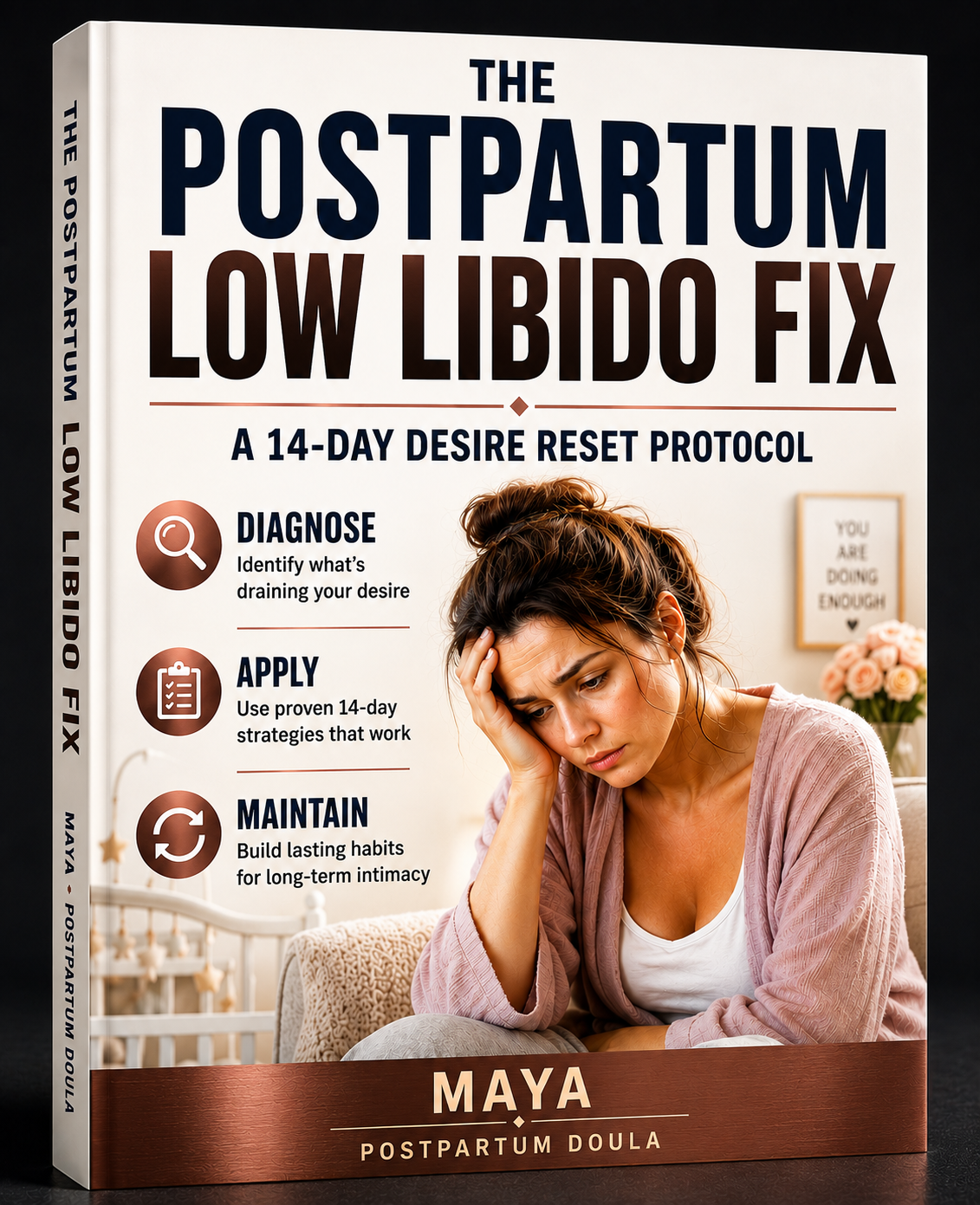
Everything Nurse Odalys taught me, organized so any exhausted mother can actually follow it — no willpower required, no forcing anything.
- The nervous-system reason desire disappears postpartum — and why it's not about your marriage. Pg. 3
- The 10-minute daily reconnection sequence — laid out day by day, so you never guess what comes next. Pg. 6
- The exact words to say to your partner — so pressure disappears and he finally understands. Pg. 11
- What to do on the days it doesn't feel like it's working — because recovery has quiet days too. Pg. 14
- The "safety before spark" framework — Nurse Odalys's principle, broken down simply. Pg. 17
- A simple check-in tracker — to notice the small shifts you'd otherwise miss. Pg. 20
Your Free Bonuses
Bonus 1: The Partner Conversation Script

The exact wording for the "I'm not rejecting you, I'm recovering" conversation — so your partner finally understands without you having to find the words yourself, exhausted, in the moment.
Bonus 2: The 5-Minute Wind-Down Ritual

A gentle nervous-system reset for the nights touch still feels like too much — so you have something to reach for even on the harder days.
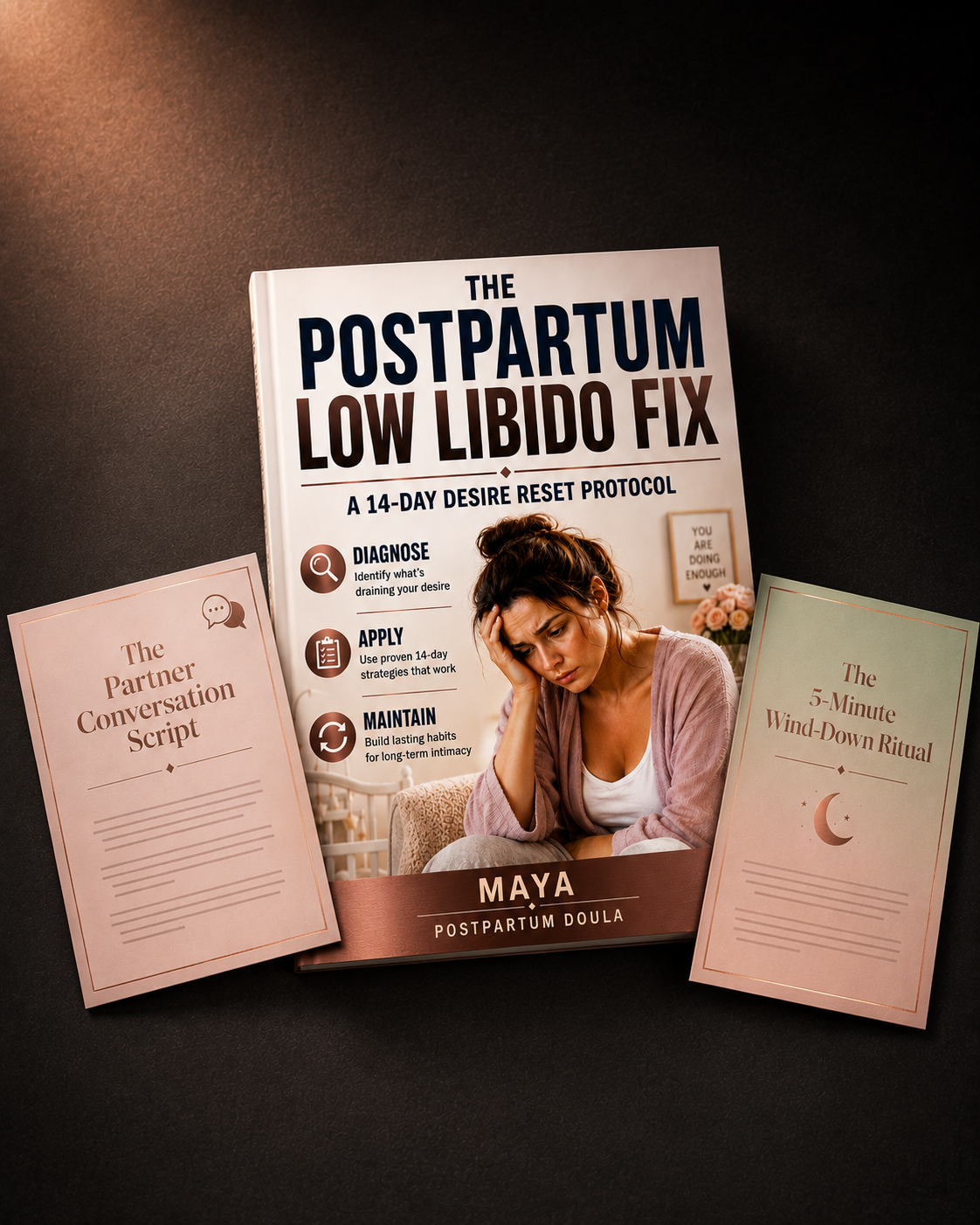
Here's Everything You're Getting Today
| The Postpartum Low Libido Fix (Main Guide) | ₦25,000 |
| Bonus 1: Partner Conversation Script | ₦15,000 |
| Bonus 2: 5-Minute Wind-Down Ritual | ₦12,000 |
| Total Real Value | ₦52,000 |
| Fair Price for All of This | ₦25,000 |
| Your Price Today | ₦6,500 |
Before You Go — Your Questions, Answered
?Is this actually going to work for my specific situation?
This guide covers women anywhere from 1 month to 3+ years postpartum, whether you're breastfeeding or not, whether your delivery was vaginal or cesarean. Chapter 3 includes a self-check to help you identify whether your experience is more physical, more emotional, or both — so the guide meets you exactly where you are, not a generic timeline.
?How is this different from the supplements and advice I've already tried?
Supplements and date nights try to force desire directly. This works because it addresses the actual mechanism underneath — your nervous system's safety response — first. That's the difference between something that's failed you before and something built specifically around why those things failed.
?Is this some kind of scam?
You're covered by a full 14-day money-back guarantee — try the protocol, and if you don't feel a real shift, email for a complete refund, no questions asked. Delivery is instant to your email the moment payment completes, and billing is fully discreet.
?Will my husband need to be involved right away?
No. The first three days are done entirely alone, rebuilding your own sense of safety before your partner is reintroduced gradually, with an exact script for that conversation included.
?What exactly happens after I pay?
You're taken straight to a secure Selar checkout. Once payment completes, your guide (plus both bonuses) is delivered instantly to your email — no waiting, no shipping, nothing else to buy.
My "Feel The Shift" Guarantee
Try the full 14-day protocol, exactly as laid out. If you don't notice a real shift in how your body feels around touch, email me and I'll refund you completely — no questions asked, no guilt, no hoops to jump through.
The only way you lose is if you do nothing.
Two Paths From Here
Option 1: Close This Page
You go back to waiting for the right moment. You keep bracing when he reaches for you. Six months from now, you're still typing the same 1am search, still telling yourself it just needs a little more time.
Option 2: Act Right Now
You follow the sequence starting tonight. Small shifts by day 5. A real spark by day 9 or 10. Fourteen days from now, you look back and realize this was the best ₦6,500 you ever spent — and you finally feel like yourself again.
P.S. — If this doesn't work for you, you don't lose anything. The guarantee means the entire risk sits with me, not you.
P.P.S. — Only 50 spots at this price this month. Once they're gone, the price returns to ₦25,000.
P.P.P.S. — You picked this page up at 1am, Googling something you've never said out loud to anyone. You are not broken, and you are not alone. Fourteen days from tonight, this can be different.