Postpartum Doula Reveals a Simple 14-Day Reset That Helps Exhausted New Moms Rebuild Real Desire — Without Forcing It, Faking It, or Feeling Guilty

It's 1:47am.
You're sitting up in bed with the baby finally latched, scrolling with one thumb because your other arm is pinned under a tiny sleeping weight you're too afraid to move.
And there it is again — that search bar, glowing in the dark.
"Will I ever feel normal again."
You've typed some version of it before. More than once. Late at night, when the house is quiet and there's no one to perform for.
Downstairs, your husband is asleep. Or maybe he's awake too, lying there, not saying anything, because he's learned not to ask anymore.
You love him. That part hasn't changed.
But somewhere between the hospital bag and the sleepless nights and the stranger staring back at you in the mirror, something else changed — something you don't have words for yet, something that makes his hand on your shoulder feel less like affection and more like a question you're not ready to answer.
You keep waiting to feel like yourself again.
Everyone told you it just takes time. Your doctor said it at the six-week check-up, rushed and distracted, already halfway out the door. Your mother said it. Your friends who had babies years ago said it, a little too breezily, like they'd forgotten what "just wait" actually feels like at month four. Month eight. Month fourteen.
How long is "just time" supposed to take?
You're not asking for fireworks. You're not asking to feel like a teenager again. You just want to not dread it. You want to stop bracing every time he gets close, stop apologizing with your eyes, stop wondering if this is just what motherhood quietly takes from every woman and nobody warns you.
Drop what you are doing. Read every word of what I am about to share with you.
This isn't something new. It isn't a trend, a hack, or something a wellness influencer invented last year for clicks. It's older than that — quietly passed between women who've actually lived through it, long before it ever had a name.
My name is Maya.
First thing I want you to know — I am not a doctor. I am not a therapist. I am not an online coach selling a lifestyle. I am just a postpartum doula who has sat on the edges of hundreds of new mothers' beds, and who quietly suffered through this exact problem myself for 18 months before I finally found what actually works.
I'm going to tell you exactly how that happened. All of it. Not the polished version.

My second son was born on a rainy Tuesday in Lagos, a little over three years ago. Easier delivery than my first, healthy baby, healthy me — on paper, nothing was wrong.
But somewhere in those first few weeks, something in me just... switched off.
It wasn't dramatic. There was no fight, no moment where my husband and I sat down and named it. It was quieter than that — a hand on my back that I found myself flinching away from without meaning to. A goodnight kiss that I turned my head slightly to avoid, then immediately felt guilty about. A closeness that used to feel like home now felt like a demand I couldn't meet.
I told myself it was normal. I'd supported enough new mothers by then to know the textbook explanation — hormones, exhaustion, recovery. I gave myself the six-week grace period everyone talks about.
Six weeks came and went. Then three months. Then six.
That's when the emotional cost really started showing up.
I stopped changing in front of him. I started going to bed before him on purpose, pretending to already be asleep by the time he came upstairs. I'd catch him looking at me sometimes with this expression — not angry, just confused, maybe a little hurt — and I'd look away first, every time, because I didn't have an explanation that made sense even to me.
Was I broken? Did I not love him the way I used to? Was this just what happened to women after two babies — did nobody actually get their desire back, and everyone was just performing?
I never said any of this out loud. Not to my husband. Not to my own mother. I was the doula. I was supposed to be the one who had this figured out for everyone else.
The breaking point came on an ordinary Thursday night, ten months in. My husband reached for my hand across the couch — nothing more than that, just my hand — and I pulled it away so fast it startled both of us. He didn't say anything. He just got up and went to bed early.
I sat alone in the living room and cried in a way I hadn't let myself cry in months. Not because of what happened, but because of what it meant. I couldn't keep doing this to him. To us. To myself.
The next morning I called my godmother, Auntie Ngozi, mostly just to hear a voice that wasn't asking anything of me. I ended up telling her everything — the flinching, the avoiding, the shame I hadn't named until it came pouring out of me on the phone.
She was quiet for a moment. Then she said, "Maya, nobody ever tells a new mother that her body has to learn how to feel safe again before it can learn how to want anything. You are not broken. You are just still recovering, and recovery doesn't stop when the doctor discharges you."
I didn't fully understand what she meant yet. But something about it stayed with me.
In the months after that call, I tried everything.
Date nights — we booked a sitter, dressed up, tried to recreate the version of us from before the kids. It made things worse, not better. The pressure of the whole evening building toward something just made me more anxious, not less.
Lingerie, "spicing things up" — I bought things I never wore, because none of it touched the actual problem. My body wasn't rejecting romance. It was rejecting the fear underneath it.
Waiting it out — months passed. Nothing changed on its own.
Couples therapy — we went twice. Good communication advice, but nothing that actually addressed what was happening in my body, only what was happening in our conversations.
A hormone-focused supplement a friend swore by — I took it faithfully for six weeks. No noticeable difference at all.
I followed postpartum body influencers on Instagram, hoping for real steps. Just vague affirmations. "Be patient with yourself." Nobody told me how.
And once, out of sheer desperation, I just pushed through intimacy anyway, hoping my body would "remember." It left me feeling worse than before — more disconnected, more convinced something was permanently wrong with me.
I was exhausted from trying and failing on repeat.
The chance encounter happened almost eighteen months in, while I was shadowing postpartum rounds at a hospital on the mainland — something I still did occasionally to stay sharp in my work, even while quietly falling apart in my own home. That's where I met Nurse Odalys.
She was 61, been doing labor-and-delivery for over three decades, the kind of nurse who called every exhausted new mother "my dear" and meant it. We were in the break room during a lull, and I mentioned, almost as a professional aside, how many of my clients struggled with intimacy months after birth.
She looked at me for a long moment and said, "You mean like you're struggling right now?"
I don't know what gave it away. Maybe doulas aren't as good at hiding things as we think we are.
That's when she told me the thing that changed everything.
"Everyone treats this like a desire problem," she said, stirring her tea. "It's not. It's a safety problem. Your body went through something enormous, and now it's doing exactly what bodies are built to do after something enormous — it's protecting you. Desire cannot exist in a nervous system that still thinks it needs to be on guard. You don't need to force desire back. You need to teach your body it's safe again. The wanting comes after — the same way milk comes in. Biology, not brokenness."
I almost didn't take it seriously. It sounded too simple. Too gentle. Almost too much like something my own grandmother would've said, wrapped in a proverb, while she pounded yam in the kitchen.
I've spent eight years studying evidence-based postpartum care, I remember thinking. Surely it's more complicated than "feel safe first."
But nothing else had worked. So I asked her to show me exactly what she meant.
What she gave me wasn't a supplement or a date-night plan. It was a sequence — ten to fifteen minutes a day, done alone at first, gentle nervous-system and body-reconnection work, before any partner involvement at all. Then, later, simple, low-pressure ways to bring my husband back in, without either of us performing.
The first few days, nothing happened. I sat with the exercises feeling a little silly, wondering if I'd wasted my hope on something too soft to work. By day three I nearly stopped altogether.
Then, around day five, I noticed something small: I didn't flinch when my husband put his hand on my back while I was washing dishes. I actually let it stay there.
It doesn't sound like much. But I stood at that sink and felt my eyes fill up, because that was the first time in over a year my body hadn't treated his touch like a threat.
By day ten, something shifted further — a real, unmistakable pull toward him, not just an absence of dread. I remember standing in the kitchen doorway watching him read to our son and feeling something stir in my chest that I hadn't let myself feel in so long I'd almost forgotten the shape of it.
Two weeks after I started, my husband said something I still think about. We were folding laundry, nothing special happening, and he stopped and looked at me and said, "You seem lighter lately. Like you're actually here with me again, not just next to me."
I had to leave the room for a second. He had no idea what those words meant to me.
I quietly shared what Nurse Odalys taught me with two other mothers from my client circle who'd confided similar struggles — one nine months postpartum, one almost two years out. Both told me, within weeks, they noticed the same thing I had: less bracing, less dread, and eventually, real wanting instead of quiet endurance.
After that, word spread quietly among the mothers I worked with. I started getting message after message from women asking me to explain the sequence, write it down, send it over.
So I put the full method inside one simple guide. The exact steps. The daily sequence. The timing. The words to say to a partner. What to do on the days it doesn't feel like it's working. Everything Nurse Odalys taught me, organized so any exhausted new mother could actually follow it — no willpower required, no forcing anything.
So that nobody else has to go through what I went through, trying to figure this out completely alone.
Introducing...
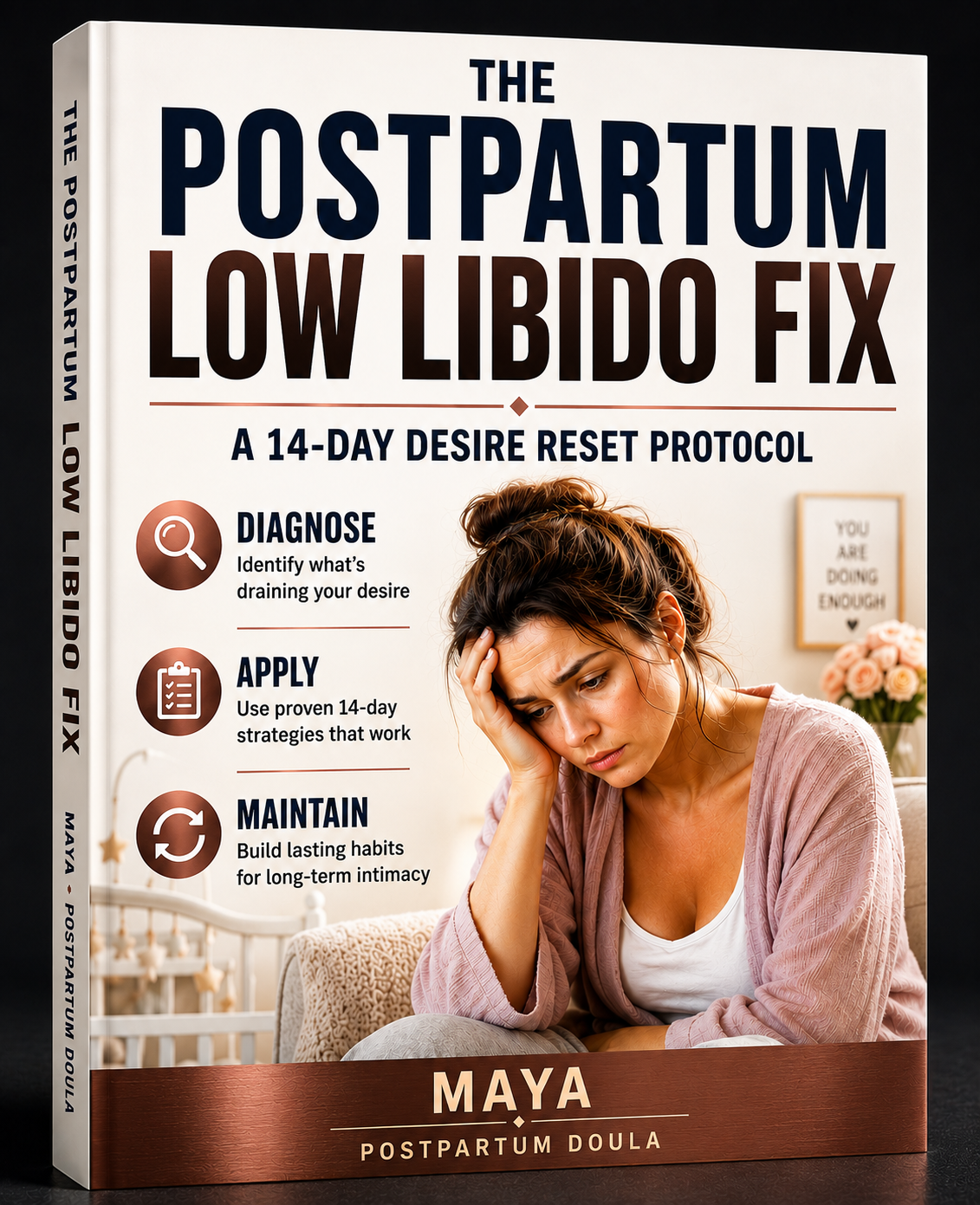
The Postpartum Low Libido Fix
A 14-Day Desire Reset Protocol
Here is exactly what is waiting for you inside:
- The real reason desire disappears after birth — the nervous-system science behind it, and why it's not about your marriage. Pg. 3
- The 10-minute daily reconnection sequence — laid out day by day, so you never have to guess what comes next. Pg. 6
- The exact words to say to your partner — so the pressure disappears and he finally understands what's actually happening. Pg. 11
- What to do on the days it doesn't feel like it's working — because every recovery has quiet days, and you won't be left guessing. Pg. 14
- The "safety before spark" framework — the exact principle Nurse Odalys taught me, broken down simply. Pg. 17
- A simple check-in tracker — to notice the small shifts you'd otherwise miss along the way. Pg. 20
And the best part? You do not need to force it. You do not need to fake it. You do not need to feel guilty for how long this has taken. It is the same simple method that worked for me — and has since quietly worked for over 30 mothers I have personally walked through it.
What Other New Moms Are Saying
Before I Tell You the Price... Let Me Be Honest About What It Cost Me to Create This.
This wasn't thrown together over a weekend. Between everything that went into it, here's what actually went in:
- Dozens of hours of doula consulting time, refining the sequence with real mothers
- A professional editor to make sure every page was clear and usable, not clinical
- Months of testing the protocol with volunteer mothers before I trusted it enough to share it
- Professional design work for the guide and the tracker
- Nurse Odalys's own time and knowledge, gathered over three decades of hands-on postpartum care
- Website and delivery system costs to get this into your hands instantly
This took me over N700,000 in doula consulting hours, editing, and design to put together properly.
Once those spots are gone, the price goes back up. Do not close this page and come back later expecting to pay the same amount.
Wait — I'm Not Done Yet. If You're Among the First 50 Moms, You Also Get These Free Gifts:

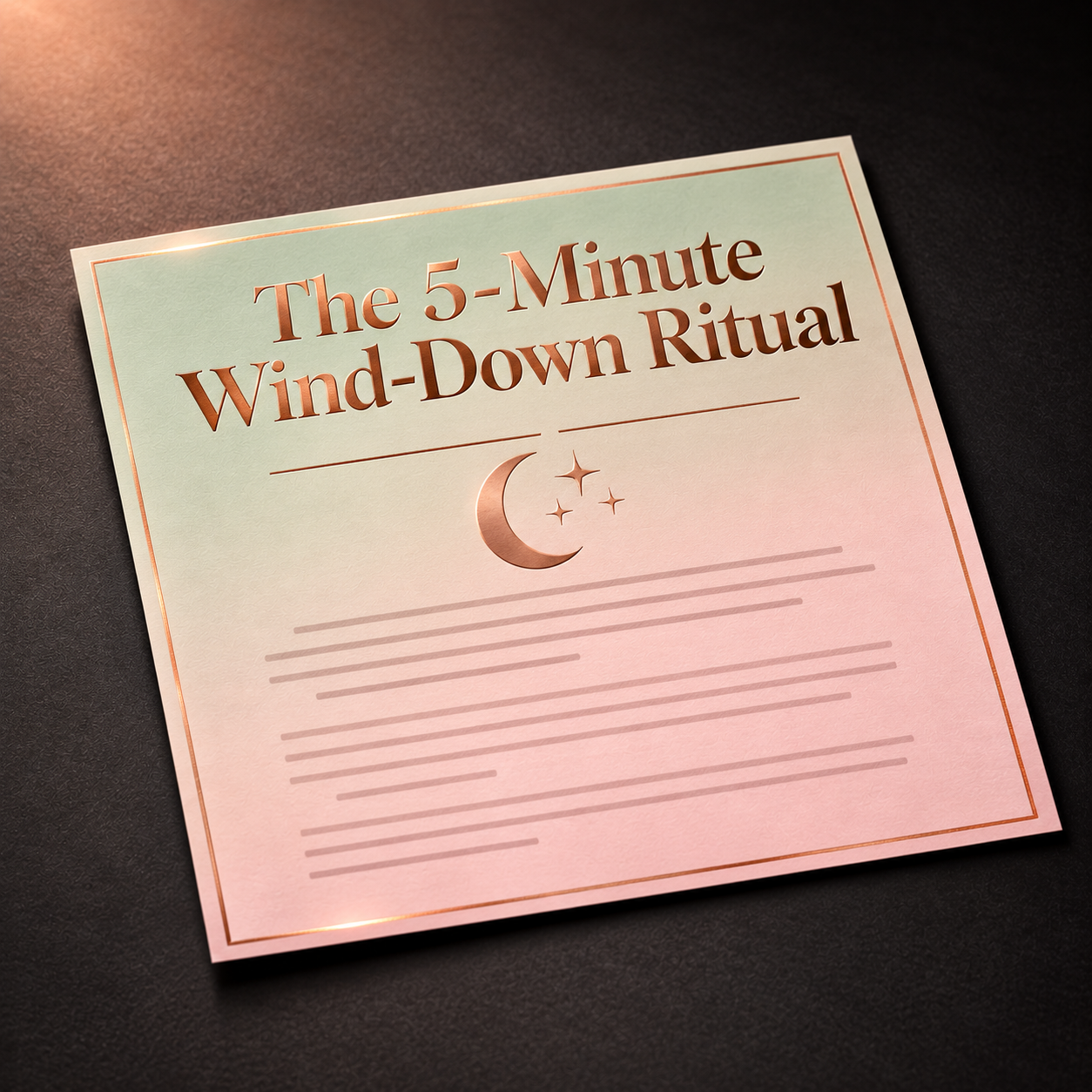
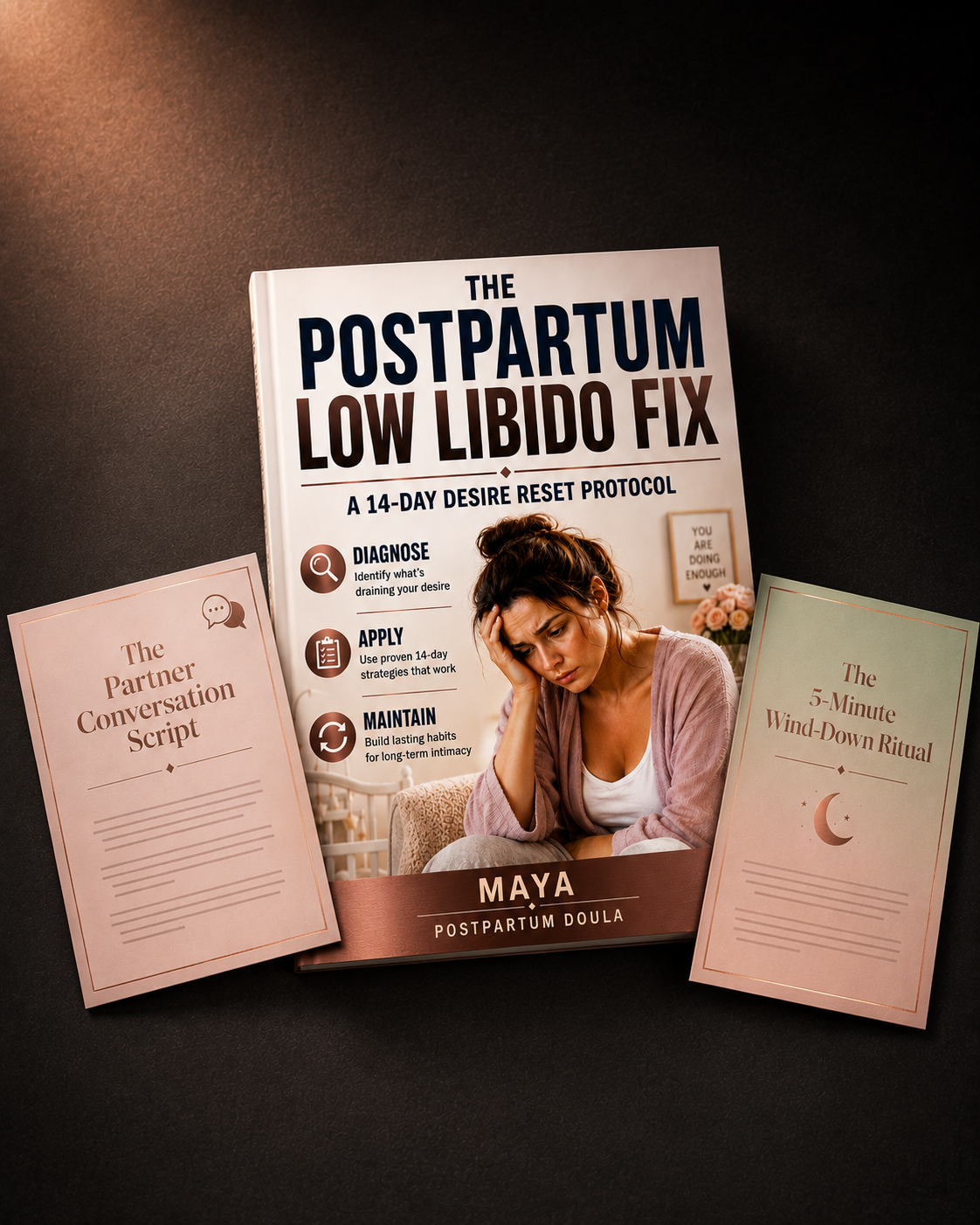
Still on the fence? I completely understand. Which is why I'm taking all the risk away from you.
Try the full 14-day protocol. Follow it exactly as laid out. If you don't notice a real shift in how your body feels around touch, email me and I'll refund you completely — no questions asked, no guilt, no hoops to jump through.
The only way you lose is if you do nothing.
Get The Postpartum Low Libido Fix Right NowMore Moms Who Got Their Spark Back
You take action today. You follow the simple steps inside The Postpartum Low Libido Fix. You start seeing real changes within the first 5 to 11 days. Your marriage begins to shift, quietly, at your own pace. You look back in 30 days and realize this was the best N6,500 you ever spent.
Or you close this page. You go back to waiting it out, hoping it resolves itself. You keep spending money on things that disappoint you. You wonder, for a long time, whether this would have worked if you had just tried it.
Only you can make that decision. But I'll tell you this — the people who are inside that chat right now already made theirs.